Understanding ISO 17712 Certified Container Bolt Seals
In the intricate web of international container shipping, where cargo passes through dozens of hands and thousands of miles, trust must be engineered, not assumed. This engineered trust is epitomized by a small but critical component: the ISO 17712 certified container bolt seal. For B2B buyers, logistics directors, and compliance officers, this certification is far more than an acronym on a spec sheet—it is the definitive, globally recognized passport for cargo security. This article deconstructs the ISO 17712 standard, explaining not just what it is, but why it is the indispensable foundation of modern supply chain integrity and how to ensure your seals genuinely meet its rigorous demands.
What is ISO 17712? The Genesis of a Global Standard
The International Organization for Standardization (ISO) developed ISO 17712 to establish uniform, testable requirements for mechanical seals used on freight containers. Prior to its widespread adoption, the market was fragmented with seals of wildly varying quality, making it impossible for shippers, carriers, and insurers to have consistent security expectations. The standard, formally titled “Freight containers — Mechanical seals,” provides a common language and a clear set of technical benchmarks. Its primary objective is to deter and detect tampering by ensuring that high security bolt seals offer a defined level of resistance to forced entry, thereby safeguarding the container's chain of custody.
The Three Security Classifications: I, S, and H
A core concept of ISO 17712 is its tripartite classification system, which allows users to match the seal to the risk profile. Understanding these classifications is fundamental to procurement.
‘I’ – Indicative Seals: These are basic seals intended to provide visual evidence of tampering only. They are not designed to resist deliberate forced entry. Think of a simple plastic pull-tight seal. They are suitable for low-risk, internal logistics where the primary need is to indicate if a door was opened, not to prevent it.
‘S’ – Security Seals: This class offers a greater level of tamper resistance than Indicative seals but does not meet the stringent testing requirements of the ‘H’ class. Their use in international container shipping is limited and often not accepted by carriers or insurers for high-value cargo.
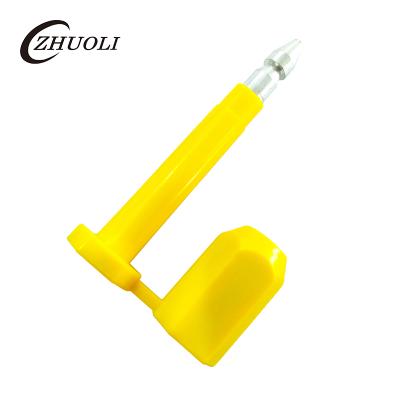
‘H’ – High Security Seals: This is the gold standard and the only classification relevant for serious international B2B shipping. ISO 17712 certified bolt seals carrying the ‘H’ mark have passed a battery of destructive physical tests. When sourcing container security seals, specifying ISO 17712 ‘H’ is non-negotiable for protecting your assets and ensuring compliance.
The Crucible of Certification: The Mandatory ‘H’ Grade Tests
The authority of the ISO 17712 certification comes from its rigorous, quantifiable testing protocol. To earn the ‘H’ mark, a bolt seal must be submitted to an accredited independent laboratory where it undergoes and passes the following:
Tensile Strength Test: The seal is pulled apart axially. The force required to cause failure must meet a high minimum threshold (measured in kilonewtons or kilogram-force). This tests the seal’s resistance to being yanked or pried apart.
Shear Strength Test: The bolt (the pin) of the seal is subjected to a cutting force. This measures its ability to resist bolt cutters or similar tools. The required minimum force is substantial, ensuring only quality, hardened steel can pass.
Impact Resistance Test: The sealed assembly is struck with a heavy pendulum or weight. This simulates an attack with a hammer or similar blunt instrument and tests the durability of the locking mechanism and housing.
Environmental & Durability Tests (as per manufacturer’s claims): If a seal is marketed as “weather-resistant” or “corrosion-resistant,” it must also withstand specified salt spray, temperature, and UV exposure tests to validate those claims.
A genuine ISO 17712 certified seal comes with a test certificate from the accredited lab, traceable to the specific production batch. Reputable manufacturers, such as Zhuoli, make these certificates readily available to B2B clients, providing transparent proof of performance.
Why ‘H’ Certification is Non-Negotiable for B2B Operations
The choice to use ISO 17712 ‘H’ certified container bolt seals is a strategic business decision with direct impacts on liability, cost, and operational fluidity.
Insurance and Carrier Compliance: Virtually all marine cargo insurance policies and global shipping line contracts now mandate the use of high security seals that meet ISO 17712 ‘H’. Failure to comply can provide grounds for an insurer to deny a theft claim, arguing contributory negligence. It is your first and most straightforward defense in a claim dispute.
Supply Chain Integrity & Tamper Evidence: The certification provides assurance that the seal will perform as a reliable forensic tool. It will either remain intact or fail in a visibly obvious way, providing clear evidence for your tamper-evident security protocol. This protects against internal and external pilferage.
Global Customs & Security Facilitation: Customs authorities worldwide recognize and respect the ISO 17712 standard. Containers sealed with certified ‘H’ grade seals are often processed more efficiently, as they represent a lower risk profile and a commitment to secure shipping practices.
Risk Mitigation and Due Diligence: Using certified seals is a demonstrable act of due diligence. It shows regulators, clients, and partners that you take supply chain security seriously. This protects not only your cargo but also your company’s reputation.
Beyond the Mark: Practical Steps for B2B Buyers
Knowing the standard is one thing; applying that knowledge in procurement is another.
Demand the Certificate: Never accept a supplier’s verbal assurance. Always request the official ISO 17712 test certificate for the specific seal model you are purchasing. Verify the issuing laboratory is accredited.
Inspect the Seal Itself: A certified seal will be permanently marked. Look for:
The manufacturer’s identification mark or logo.
A unique serial number.
The ISO 17712 ‘H’ designation mark.
Partner with Certified Manufacturers: Work with established manufacturers like Zhuoli, whose core business is built around compliant security products. They invest in the testing, quality control, and material science required to consistently meet the standard, batch after batch.
Beware of Counterfeits and “Equivalent” Claims: The market has products with misleading stamps or claims of being “ISO-style” or “meeting the spirit of 17712.” These are red flags. There is no equivalent; there is only compliance or non-compliance.
Conclusion: The Seal of Trust in a Sealed World
Understanding ISO 17712 certified container bolt seals is to understand the mechanics of trust in global trade. This standard transforms a simple metal device from a commodity into a credentialed component of your risk management strategy. It is a small, cost-effective investment that carries the immense weight of proof—proof of integrity, proof of compliance, and proof of professional diligence.
In a world where supply chains are under constant scrutiny, the ISO 17712 ‘H’ mark on your container bolt seal is your silent, steadfast ambassador of security. It speaks a global language of resilience that ports, insurers, and criminals all understand.
Don’t Just Seal Your Container; Certify Your Security.
Verify your current seals. Do they carry the genuine ISO 17712 ‘H’ mark and a valid test certificate? If there’s any doubt, it’s a vulnerability.
Contact Zhuoli Security today to request a technical dossier on our fully certified ISO 17712 ‘H’ grade bolt seal range, including batch-test documentation. Let us help you turn a compliance requirement into a competitive advantage in security and reliability.