The Role of High Security Bolt Seals in Chemical Container Shipping
The global transportation of chemical products represents one of the most demanding and high-stakes segments of international logistics. Moving corrosive, flammable, toxic, or otherwise hazardous materials requires an uncompromising commitment to safety, security, and regulatory compliance. Beyond the specialized packaging and handling protocols, the physical integrity of the shipping container itself is a paramount concern. A single breach, whether from tampering, theft, or accidental opening, can lead to catastrophic safety incidents, environmental damage, severe financial loss, and irreparable brand damage. In this critical context, the high security bolt seal transitions from a basic locking device to an indispensable component of a comprehensive risk management strategy. This article examines the pivotal role these seals play in chemical container shipping, detailing their specialized features, the stringent standards they must meet, and their contribution to securing the global chemical supply chain.
Navigating a High-Risk Environment: The Unique Demands of Chemical Logistics
The chemical shipping industry operates within a tightly regulated global framework governed by international codes such as the IMDG (International Maritime Dangerous Goods) Code. These regulations mandate rigorous standards for every aspect of transportation, from container specifications to documentation. Security is not merely a best practice; it is a codified requirement. The potential consequences of failure—including safety hazards, environmental contamination, and supply chain disruption—are magnified compared to standard cargo.
Key Security Challenges in Chemical Shipping:
Pilferage and Theft: High-value raw materials and finished chemical products are attractive targets for organized cargo theft.
Tampering and Contamination: Deliberate or accidental tampering can lead to product contamination, cross-mixing, or the introduction of foreign substances, rendering entire shipments unfit for purpose.
Regulatory Scrutiny and Chain of Custody: Authorities demand verifiable proof of an unbroken chain of custody. Any gap in the physical security record can result in delays, fines, or seizure of cargo.
Insurance and Liability: Insurers closely examine security protocols when underwriting policies or assessing claims. The use of non-compliant or substandard seals can jeopardize coverage.
This environment necessitates a sealing solution that offers superior physical strength, unambiguous tamper-evidence, and formal international certification—a role fulfilled exclusively by ISO 17712 certified high security seals.
Engineering Integrity: Features of High Security Bolt Seals for Chemical Applications
A standard seal is insufficient for the rigors of hazardous material container security. High security bolt seals used in this sector are engineered with specific attributes to withstand both malicious attacks and harsh environmental conditions.
1. Robust Physical Construction and Tamper Evidence:
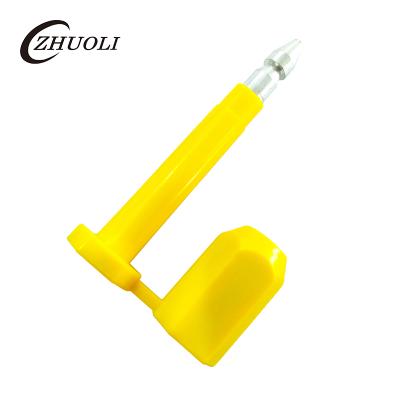
The fundamental design involves a hardened steel bolt (or pin) that locks irreversibly into a durable steel body. This configuration provides exceptional resistance to pulling, prying, and twisting attacks. For chemical container shipping, seals often feature:
Heavy-Duty Bolt Diameter: Thicker bolts offer increased shear strength, making them extremely difficult to cut with handheld tools.
Anti-Tamper Locking Mechanisms: Advanced designs may include free-spinning collars, anti-drill plates, or complex internal locking geometries to resist manipulation.
Clear Tamper-Indication: Any attempt to force the seal results in permanent, visible damage to the bolt or housing, providing immediate visual evidence of a breach—a critical feature for tamper evident sealing solutions for dangerous goods.
2. Corrosion Resistance and Environmental Durability:
Chemical cargoes are often transported across oceans and may be stored in corrosive port environments. Seals must endure:
Salt Spray and Humidity: High-quality seals from manufacturers like Shandong Zhuoli Electric Appliance Co., Ltd. utilize hot-dip galvanizing or zinc-nickel alloy plating to provide a robust barrier against rust and corrosion, ensuring the seal remains functional and legible throughout its journey.
Exposure to Chemical Fumes: The seal's plating and markings must be resistant to degradation from ambient chemical vapors.
3. Unique Identification and Traceability:
Each seal is permanently marked with a unique, sequential serial number, typically laser-etched for durability. This number is meticulously recorded on shipping manifests, bills of lading, and digital tracking systems. This creates an auditable link between the physical container and its documentation, forming the cornerstone of a verifiable secure chain of custody for chemical logistics. For enhanced tracking, seals can be paired with barcode or RFID tags.
The Compliance Imperative: ISO 17712 Certification
For international shipping, and particularly for hazardous materials, ISO 17712 is the globally recognized standard for mechanical seals. It classifies seals into three security levels: 'I' (Indicative), 'S' (Security), and 'H' (High Security). Chemical container shipping universally requires 'H'-rated seals.
What ISO 17712 'H' Certification Ensures:
Independent Testing: The seal model has undergone rigorous laboratory testing for tensile strength, shear strength, impact resistance, and tamper-resistance.
Manufacturing Consistency: The certification assures that every seal produced under that model meets the same high-performance criteria.
Global Acceptance: Port authorities, customs agencies, and receiving parties worldwide recognize and require this certification as proof of due diligence. Utilizing ISO 17712 certified bolt seals for hazardous materials is non-negotiable for compliant operations.
From Production to Application: A Synergy of Quality and Procedure
The effectiveness of a high security bolt seal is determined by both its manufacturing quality and its correct application.
Manufacturing Excellence at Shandong Zhuoli Electric Appliance Co., Ltd.:
As a professional manufacturer, Shandong Zhuuli integrates precision engineering with strict quality control. The process involves CNC machining of hardened steel components, advanced electroplating for corrosion protection, and laser marking for permanent identification. Each production batch is subjected to statistical destructive testing to verify continued compliance with strength specifications. This commitment to manufacturing integrity ensures that their heavy duty bolt seals for tank containers and dry freight containers deliver reliable performance.
The Critical Application Protocol:
The best seal is only as good as its application. A standardized procedure is vital:
Verification & Record: Prior to application, the seal's unique number is verified and recorded in all transport documents.
Proper Installation: The bolt is fully inserted through the container door hasps and decisively locked into the body until a positive click is felt or heard. An improperly seated seal is a security failure.
Visual Inspection at Handover: At each transfer point (port, terminal, border), personnel must visually inspect the seal, confirm its number matches the paperwork, and look for any signs of tampering before accepting custody.
This protocol transforms the seal from a passive component into an active agent of supply chain security for bulk chemical transport.
Conclusion: An Investment in Safety, Security, and Compliance
In the high-consequence world of chemical container shipping, high security bolt seals are a fundamental and cost-effective investment. They provide a physical and evidentiary barrier against theft and tampering, uphold the integrity of the chain of custody, and demonstrate a company's commitment to regulatory compliance and safety. Specifying ISO 17712 'H' certified seals from a reputable manufacturer is a clear indicator of professional supply chain management.
For chemical producers, logistics providers, and shippers, the question is not whether to use high-security seals, but rather, if your current sealing solution provides the demonstrable strength, certification, and durability required for your high-risk shipments.
Actionable Call for B2B Buyers:
Conduct a thorough review of your current container sealing protocol. Scrutinize the certifications, material specifications, and track record of your seal supplier.
We advise you to contact a certified manufacturer like Shandong Zhuoli Electric Appliance Co., Ltd. to request detailed technical documentation, third-party certification proofs, and samples of their high security bolt seals for rigorous in-house evaluation. Assess their resistance to cutting and corrosion, and validate their compatibility with your tracking systems. Ensure your first line of defense is as resilient as the safety standards you are mandated to uphold.